


Why Eating Time Matters: A Critical Component for Precision Farming
As dairy producers increasingly adopt Precision Livestock Farming technologies, the debate between wearable neck sensors (collars/ear tags) and internal devices (rumen boluses) has intensified. Both technologies offer transformative insights into herd health, estrus detection and heat stress. However, when the conversation shifts to key profitability drivers – feed efficiency and dry matter intake (DMI) – […]
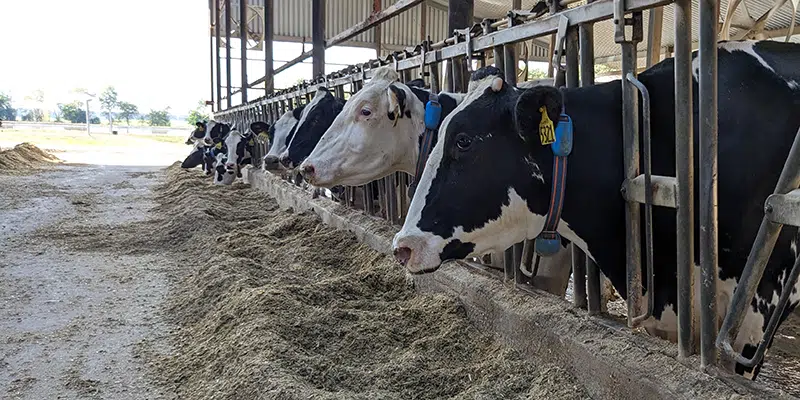
As dairy producers increasingly adopt Precision Livestock Farming technologies, the debate between wearable neck sensors (collars/ear tags) and internal devices (rumen boluses) has intensified. Both technologies offer transformative insights into herd health, estrus detection and heat stress. However, when the conversation shifts to key profitability drivers – feed efficiency and dry matter intake (DMI) – a critical distinction emerges. Based on recent comparative research, neck collars possess a distinct advantage over bolus technology: the ability to accurately measure eating behavior through dairy cow eating time monitoring.
The Mechanics of Cow Monitoring
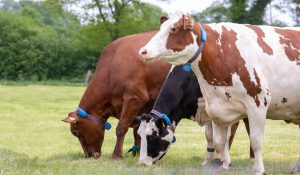
To understand the disparity, one must look at what is actually being measured. Accelerometer-based collars, such as the AfiCollar, are positioned on the neck to detect specific 3D movement patterns associated with jaw mechanics and head positioning. This allows the sensor’s algorithms to differentiate between distinct behaviors: rumination, grazing/eating, and general activity, making them highly effective tools for dairy cow eating time monitoring.
In contrast, a bolus sits within the reticulum. While highly effective at measuring internal physiological parameters like reticulorumen temperature and pH, its ability to monitor specific ingestion behavior is limited by its location. Research comparing these technologies highlights a significant data gap. While collars report specific eating time in minutes per day, bolus systems (such as smaXtec) report a generalized Activity Index and lack true dairy cow eating time monitoring capability.
Neck collars possess a distinct advantage over bolus technology: the ability to accurately measure eating behavior through dairy cow eating time monitoring.
The Accuracy of Intake Prediction
The inability to isolate eating time has cascading effects on farm management. In a recent study, sensors that recorded both rumination and eating behavior (like collars) achieved significantly higher predictive accuracy (Adjusted-R² of up to 0.58) compared to technologies that relied solely on activity or lacked specific eating metrics.
Without a precise measurement of the time spent eating through dairy cow eating time monitoring, the equation for intake remains unsolvable. Research explicitly notes that because boluses rely on rumen motility and general accelerometers, they do not capture eating time as directly as head-mounted sensors, limiting their utility and effectiveness for dairy cow eating time monitoring.
The Feed Efficiency Blind Spot
The most significant commercial implication of this technological difference lies in the calculation of Feed Efficiency (FE). FE is generally defined as the ratio of milk produced to Dry Matter Intake (DMI). As the industry moves toward breeding and managing for more efficient cows to reduce costs and methane emissions, knowing individual DMI is non-negotiable. Since bolus technology does not measure eating time, it cannot estimate individual DMI. Without DMI, a producer cannot calculate feed efficiency, highlighting the importance of dairy cow eating time monitoring.
Precision Dairy Tactics Demand the Right Data
While both technologies have proven value, their differences become more discernible when nutrition enters the discussion.
Precision is no longer about collecting more data. It is about collecting the right data. In the race toward more efficient, sustainable dairying, understanding how long a cow eats – enabled by dairy cow eating time monitoring – may be the metric that separates observation from optimization.
Edwards, J.P., et al. (2024). “On-animal sensors may predict paddock level pasture mass in rotationally grazed dairy systems.” Computers and Electronics in Agriculture.
Hofmann, W., et al. (2024). “Assessing the validity of sensor-based predictions of post-grazing residual in dairy systems.” Journal of New Zealand Grasslands.
Castaneda, A., et al. (2025). “Investigating rumination and eating time as proxies for identifying dairy cows with low methane-emitting potential.” Journal of Dairy Science Communications.