


From Dairyman to Economist: The Feed Efficiency Revolution and the Shift to Profit-Based Management
Oren Drori, VP Products and AI, Afimilk Ltd.
A New Paradigm in Herd Management In modern agriculture, where profit margins are eroding making efficiency a necessity, dairy producers’ mindsets must shift from management based on raw production to management based purely on economic metrics, most notably income over feed costs (IOFC).
A New Paradigm in Herd Management
In modern agriculture, where profit margins are eroding making efficiency a necessity, dairy producers’ mindsets must shift from management based on raw production to management based purely on economic metrics, most notably income over feed costs (IOFC).
An analysis of lactation curves reveals an interesting anomaly: while cows produce a significant amount of milk in the second half of lactation, the contribution to net profit drops dramatically during this period because feed consumption does not decrease in proportion to the drop in milk.
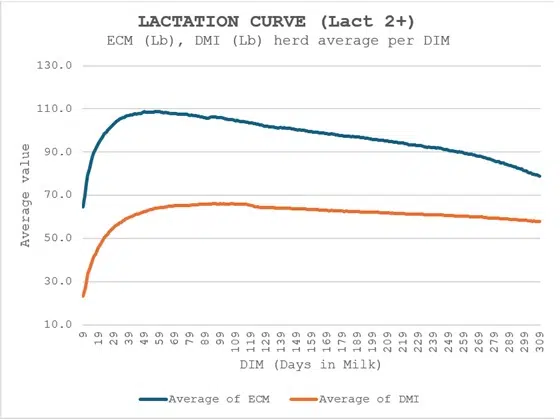
Figure 1: Energy corrected milk (ECM), dry matter intake –
results calculated using Afimilk sensors (Milk Meter, AfiLab, AfiCollar)
While this level of assessment addresses profit (IOFC) rather than just raw output, the real challenge lies in implementing a profit-oriented strategy at the individual cow level. The absence of accurate individual feed intake data has forced producers to develop management techniques based on averages, which fails to reflect complex biological and economic realities. Afimilk’s latest technological breakthrough bridges this gap.
The Third Generation of Monitoring Tackles Individual Feed Intake
While the first generation of Afimilk cow monitoring sensors (collars and leg tags) focused on heat detection, and the second generation added health and welfare monitoring (rumination, calving detection), the third generation delivers the key to precise economic management: accurate individual cow feed intake data.
This Afimilk technology delivers a 94% accuracy rate, which was determined through comprehensive validation processes in a study spanning five years (2021-2025) that included approximately 35,000 data points against a scientific gold standard. The level of precision has been noticed by leading academic institutions worldwide and is already being used for research in genetics and methane emissions.
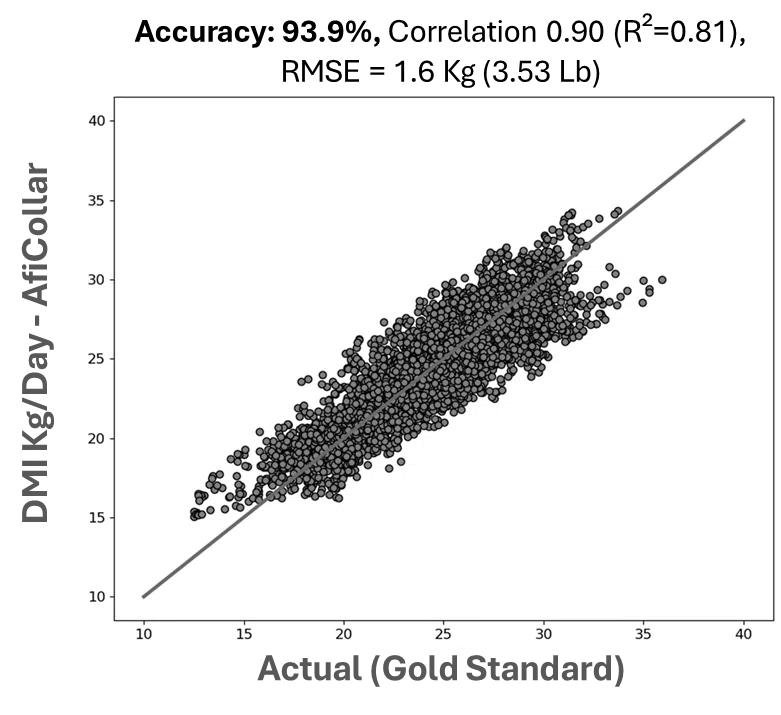
Figure 2: Comparison of 35,000 datapoints of predicted DMI predicted by Afimilk Feed Efficiency system versus actual measurements, based on research dairies in USA, Canada, and Italy over approximately 2.5 years
Consistency Identified in Cow Efficiency
Analysis of feed efficiency data found that, similar to the milk curve, a cow’s economic efficiency is an inherent and relatively stable trait. A cow that starts lactation as efficient and more profitable than her herd mates will likely maintain her status throughout the lactation, and even in subsequent lactations.
The implication for decision-makers is dramatic: the first weeks of the first lactation provide a reliable reflection of the cow’s economic future, which allows for informed decisions regarding the cow’s future at a very early stage of her productive life.
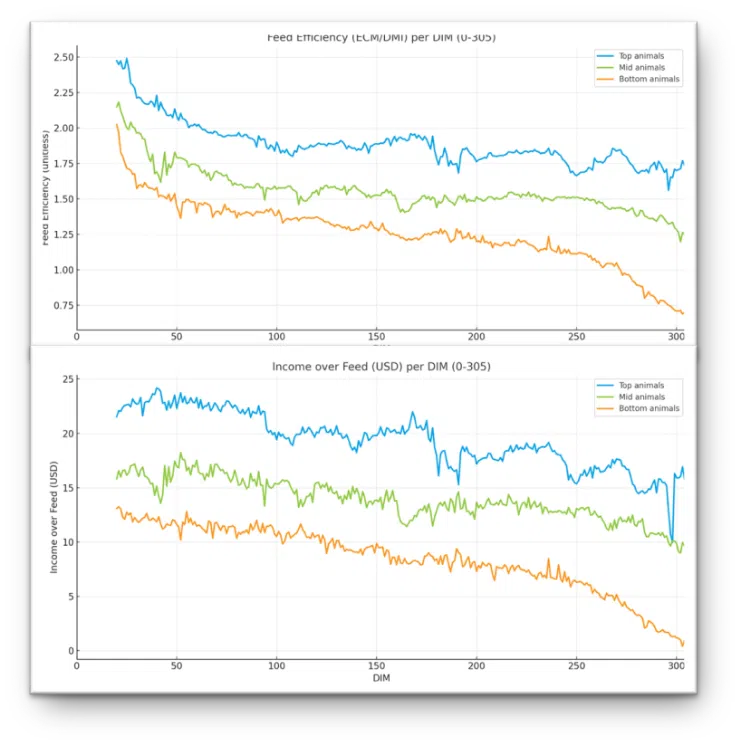
Figure 3: Cows ranked by feed efficiency at the start of lactation maintain their relative positions throughout, and similarly the relative profitability remains consistent over the course of lactation.
Management Driven by Four Feed Efficiency Classifications
When cross-referencing feed intake data with ECM production, we learned the correlation between eating and production is not linear as might be expected. Cows producing at the same level (92 lbs.) are consuming drastically different amounts of dry matter (50 lbs. vs 77 lbs.). This gap is where profitability is lost.
This insight was used to define four DMI-based classifications for cow assessments.
- The Stars: The ideal model with high milk production and relatively low feed consumption. They are the profit engines of the dairy.
- The Steady Earners: Produce less milk than average, but compensate for it with very low intake. They are stable and profitable, yet are often mistakenly culled from the herd due to a focus solely on production.
- The Deceivers: High-production cows that look excellent on the surface, but consume massive amounts of feed that erode the profit.
- The Cash Drainers: Low production, high consumption cows. Keeping them in the herd is an economic burden.
The management strategy derived from these groups uses a differential approach where the Stars should be genetically maximized using sexed semen), the Cash Drainers should be removed from the herd as soon as possible, and the Deceivers should not be preserved as the genetic basis for the next generation (use beef semen).
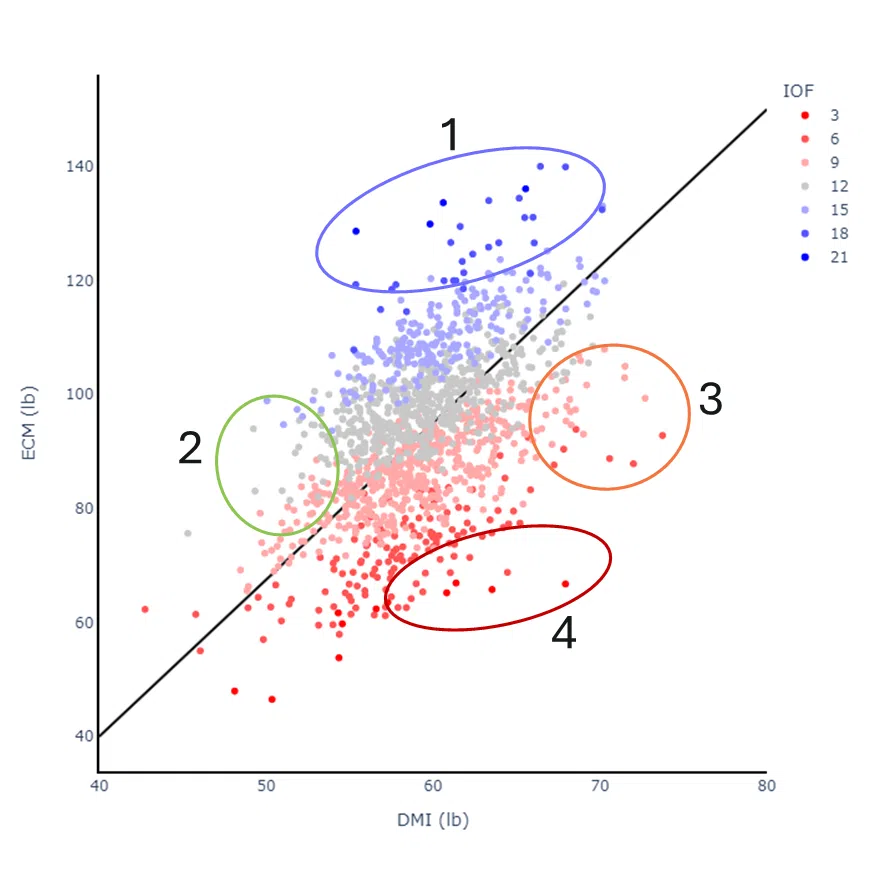
Figure 4: Sample data from a herd of 3,700 cows, showing the distribution of ECM yield versus DMI. Each point represents the five-week average up to peak lactation for an individual cow. The graph includes cows in their 2+ lactation and beyond (excluding first-lactation cows). The four profiles are marked.
The Bottom Line: Cumulative Economic Impact
An economic simulation using real data from a 1,000-cow dairy showed that implementation of this strategy, where 5% of cows with the lowest IOFC are culled annually and replaced with average cows, yielded:
- Improved feed efficiency and conversion rate.
- A decrease in dry matter consumption without compromising production.
- An improvement of $0.2 per cow per day in the first year, increasing to $0.6 in year 5, and $0.9 by year 10.
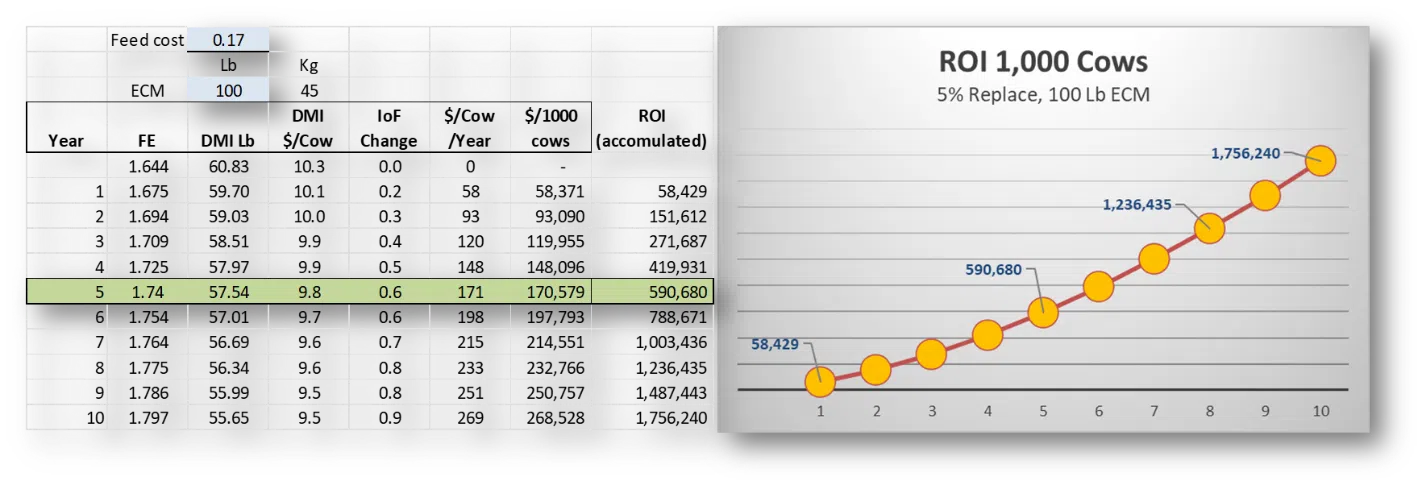
Over a decade, the cumulative effect of IOFC-based management is estimated to yield additional profit of approximately $1.75M.
Managing Profit and Loss Per Cow: The Transition from Dairyman to Economist
Turning every cow into a business unit monitored and managed based on personal profit and loss allows improves biological efficiency and also creates a significant competitive advantage in the changing dairy market.