


On a summer afternoon, a cow grazing in an open paddock carries a heat load that’s a combination of temperature, solar radiation, wind and a cow’s individual heat tolerance. If her coping mechanisms for managing that heat load are overwhelmed, her eating, production and welfare will suffer.
The Impact of Acting Sooner
Mitigating heat stress for cows on pasture takes planning: shifting the grazing rotation to shaded paddocks, moving afternoon milking, offering water and sprinklers in the yard. Knowing even an hour ahead, provides the opportunity to:
- Protect intake. Heat stress cuts grazing time and intake, which shows up as lost milk solids.
- Target mitigations. Knowing which days and mobs are most at risk helps you decide where shade, water and labour are needed.
- Support cow welfare. Panting and drooling show a cow is working to stay cool. Acting early helps keep her out of heat stress.
- Know your own herd. In a DairyNZ pilot of heat stress alerts, 31% of farmers said they lacked evidence their own herd was affected.
Understanding Regional Heat Stress Risk
Heat stress risk is not a rare event in New Zealand. DairyNZ modelling estimates the average farm faces about 55 heat stress risk days per year. That rises to 69 days in Waikato and Bay of Plenty, and 80 days in Canterbury – the country’s two largest dairy regions. The same modelling projects an additional 6–11 risk days per year by the 2050s.
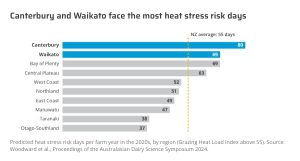
Figure 1: Predicted heat stress risk days per farm year in the 2020s, by region (Grazing Heat Load Index above 55). Source: Woodward et al.,
Proceedings of the Australasian Dairy Science Symposium 2024.
The Grazing Heat Load Index: Built for Pasture
The Temperature Humidity Index (THI) was developed for housed cows. It ignores sun and wind, which drive heat load in an open paddock. DairyNZ found that THI understates heat risk in sunny, low humidity regions: it predicts 47 risk days a year in Canterbury, where the grazing index predicts 80.
To fix that, New Zealand researchers built the Grazing Heat Load Index (GHLI). It predicts a cow’s breathing rate from air temperature, wind speed and solar radiation. In 2024 it was updated with data from 7 commercial herds and 483 Friesian × Jersey cows, from Northland to Southland. An index alone can’t tell a farmer when to act. It needs a threshold: the point where cows start to struggle.
How the Thresholds Were Set
DairyNZ and AgResearch researchers measured how cows actually responded to heat during the hottest part of the day (12:00–15:00) across two 5-day periods in January–March 2023:
- Panting time, recorded automatically by AfiCollar on cows in four herds (Northland, Auckland, Waikato and Canterbury): 14,114 hourly observations.
- Rumen temperature, from rumen sensors in four herds: 75,861 observations.
- Drooling, scored by trained observers watching each cow for 10 seconds: 7,314 observations.
- Weather, recorded on each farm at least hourly.
What the Data Showed
Cows respond to heat in a clear sequence. Drooling starts first, at a GHLI of about 46 predicted breaths per minute. Panting and rising rumen temperature follow in the low-to-mid 60s, as the cow’s first coping mechanisms are overwhelmed.
Cows start drooling near GHLI 46 and panting near 64
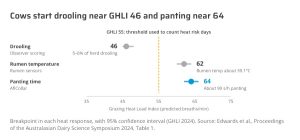
Figure 2: Breakpoint in each heat response, with 95% confidence interval (GHLI 2024). Source: Edwards et al., Proceedings of the Australasian
Dairy Science Symposium 2024, Table 1.
At the panting breakpoint, the herd averaged about 90 seconds of panting per hour, measured automatically by AfiCollar. These breakpoints sit either side of the GHLI 55 threshold proposed in
earlier NZ research and now used to count regional heat risk days.
The researchers are clear that the thresholds mark the point where heat stress risk increases, not where heat stress has occurred. That is exactly what makes them useful: they are the signal to act.
Why Each Cow Matters
Weather explained only 35–36% of the variation in individual cows’ panting time and rumen temperature. The rest came down to differences between individual cows and their conditions. Two cows in the same paddock can respond very differently on the same afternoon.
From Research to the Paddock
The panting data in this study came from the same AfiCollar many NZ farms already use for fertility and rumination monitoring.
While a forecast tells you a hot afternoon is coming, your cows – with the help of AfiCollar – tell you how hard it’s hitting them. Together they let you move a mob to shade, adjust milking times or turn on the sprinklers before production drops, and show you whether it worked.